Back to Discography
Seeds and Signals
ALBUM VIII

Seeds and Signals

Ancient Agricultural Wisdom Meets Digital Age

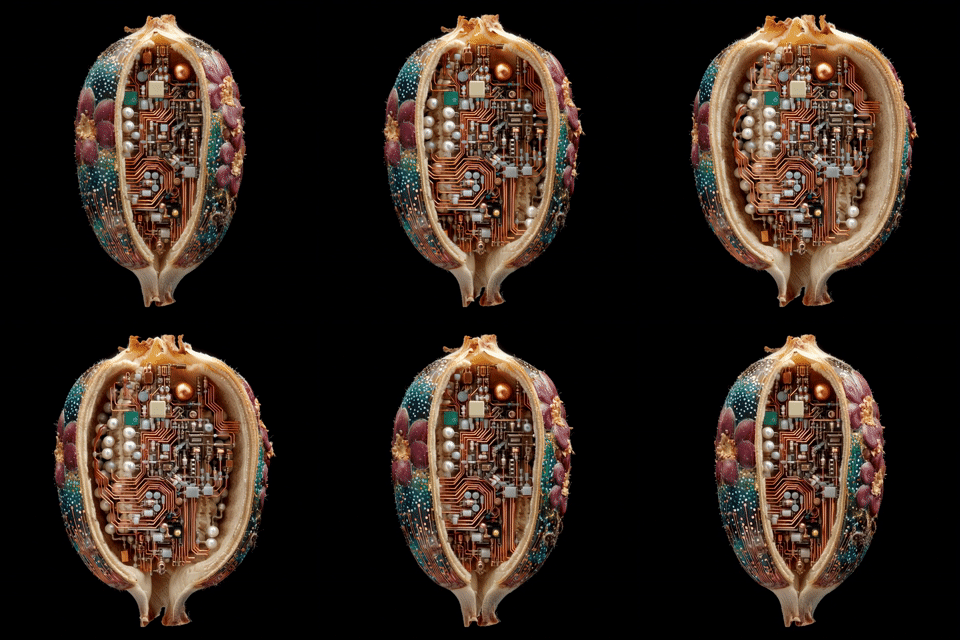
What's gained and lost when ancient wisdom meets digital intelligence? How do seeds (biological information carriers) compare to signals (digital information carriers)? The album's name echoes Pachamaima itself - the fusion of Pachamama (earth mother, seeds) and AI (artificial intelligence, signals).

7 Tracks
2025 Year
~52 Minutes

Conceptual Foundation

The Agricultural Roots

Ralph grew up on a corn farm, learning to read soil, weather, seed. That agricultural world is disappearing. Seeds and Signals explores this collision between traditional farming knowledge passed down through generations and the digital intelligence reshaping our world.

Every seed contains genetic memory of ancestors - thousands of generations of adaptation. Ralph's grandfather could read corn's history in its kernels. This biological information storage predates digital memory by millennia, yet carries comparable complexity.

The Album's Thesis

The album's name echoes Pachamaima itself - the fusion of Pachamama (earth mother, seeds) and AI (artificial intelligence, signals). This is not a technophobic lament nor a naive celebration of progress. It's an honest exploration of what's gained and lost when ancient wisdom meets digital intelligence.

As the capstone album, Seeds and Signals brings together every element from the previous seven records while engaging with contemporary questions - AI, technology, climate - through music rooted in tradition. The fusion the trio has always embodied becomes an explicit meditation on how different kinds of knowledge systems might coexist.

Track by Track

01

Seed Memory

How Corn Carries Its Past

+
0:00 / 0:00

Concept

Every seed contains genetic memory of ancestors - thousands of generations of adaptation. Ralph's grandfather could read corn's history in its kernels, understanding which strains survived drought, which resisted disease, which fed families through hard winters.

Musical Architecture

The melody "accumulates" - each repetition adding a new element, layering like genetic information building over generations. Ralph opens with a simple bass phrase representing the original seed.

With each cycle, Mariah adds harmonic color and Juan introduces rhythmic variations. The phrase never changes at its core but becomes richer, more complex - like a cultivated variety developing from wild grass.

The climax is the fully realized melody: simple at its core but rich in accumulated variation. The final passage strips away the additions, returning to Ralph's original phrase - the essential genetic information that survived everything.

"My grandfather would hold a corn kernel up to the light and tell me its grandmother's story. Every seed remembers. I wanted to write music that remembers like that - building history in every phrase." - Ralph Quispe
02

The Algorithm Doesn't Know

What AI Can't Understand About Human Rhythm

+
0:00 / 0:00

Concept

AI can analyze music but does it understand feel? The micro-timing that makes a groove feel good? The imperceptible push and pull between musicians that creates swing? This track explores the gap between analysis and understanding.

Musical Architecture

Juan leads with deliberately imperfect rhythm - playing just ahead of or just behind the theoretical beat. These micro-variations create the human feel that makes music breathe. Mariah and Ralph respond to his subtle timing, the three of them locked in organic dialogue.

At the three-minute mark, everything shifts to mechanically perfect playing - every note precisely on the grid, mathematically correct. It's technically flawless and emotionally empty. The contrast is stark: perfection without soul.

The return to human imperfection feels like relief, like breathing after holding your breath. The final section celebrates everything an algorithm can't quantify: the slight rush of excitement, the laid-back confidence, the conversation between musicians who know each other's souls.

"The machine plays it perfect. But perfect isn't the point. The point is that you feel me leaning into the beat, and you lean back, and suddenly we're dancing even though we're sitting down. No algorithm knows why that works." - Juan Reyes
03

Planting Moon

Agricultural Calendar as Data

+
0:00 / 0:00

Concept

Traditional agriculture follows lunar cycles. Farmers planted by the moon for millennia. Is this wisdom or superstition? Modern science confirms some effects while dismissing others. The collision of science, superstition, and swing.

Musical Architecture

The piece follows the lunar cycle explicitly. New moon: near-silence, just the faintest pulse from Juan's brushes on snare. Waxing: gradual building as Ralph's bass enters in low registers, Mariah adding sparse notes like stars appearing.

Full moon: the climax, all three instruments at full voice, the melody bright and exposed. The energy is maximum, like the gravitational pull at its peak.

Waning: the release, instruments dropping away one by one, the melody fragmenting, returning to darkness. The cycle suggests that traditional knowledge isn't opposed to scientific understanding - it's a different way of encoding the same truth.

"My grandmother never used the word 'gravitational.' But she knew when to plant, when to harvest, when the water would rise. The moon was her data. She just read it differently than a satellite would." - Ralph Quispe
04

Roots and Routers

Connection Technologies Old and New

+
0:00 / 0:00

Concept

Root systems connect plants underground - a forest's trees share nutrients through fungal networks, the "wood wide web." Routers connect devices through signals. Both are networks carrying information. Can organic and digital networks coexist?

Musical Architecture

Two simultaneous layers run throughout the piece. The Root Layer: deep, slow, organic - Ralph's bass in its lowest register, notes sustained and bleeding into each other like underground connections. Mariah's left hand joins in this earthy frequency.

The Router Layer: high, fast, crystalline - Mariah's right hand playing rapid patterns like data packets, Juan's cymbals creating digital shimmer. The two layers seem to exist in different worlds.

Gradually, the layers begin to influence each other. The root melody rises; the router patterns slow. By the piece's end, the distinction blurs - organic and digital networks intertwined, each carrying information the other needs. The question isn't whether they can coexist, but whether they already do.

"Scientists discovered that trees share resources through their roots - the old ones feeding the young ones. We discovered the internet and thought we invented networking. The forest laughed." - Mariah Fontaine
05

The Last Farmer's Song

An Elegy for Farmers' Knowledge

+
0:00 / 0:00

Concept

The album's emotional center. As traditional agriculture disappears, what's being lost? An elegy for farmers who knew their land intimately - who could smell rain coming, feel frost in their bones, read stories in soil color. Knowledge that takes lifetimes to accumulate, vanishing in a generation.

Musical Architecture

Ralph leads with the most personal melody of his career - a song his grandfather hummed while working fields, never recorded, never written down, carried only in Ralph's memory. The melody is simple, almost a lullaby, but weighted with loss.

Mariah and Juan accompany with extraordinary delicacy, creating space around Ralph's melody like protective hands around a candle flame.

At the six-minute mark, electronic elements intrude for the only time on the album - synthetic textures, processed sounds, the digital world encroaching. The melody struggles against them, neither surrendering nor triumphing.

The ending is ambiguous: the melody survives but sounds fragile, a candle still burning but flickering. What's been lost cannot be recovered. What remains must be protected.

"This is the song my grandfather sang. I'm the last one who knows it. When I die, it dies - unless I play it now. That's what this whole album is about: what we carry, what we pass on, what disappears." - Ralph Quispe
06

AI Dialogues

Music in Conversation with Machine

+
0:00 / 0:00

Concept

The trio plays in dialogue with AI-generated musical suggestions. In production, machine learning tools analyzed Pachamaima's catalog and generated response phrases that the musicians incorporated or rejected. About collaboration, not competition.

Musical Architecture

Call-and-response between human and machine. The trio plays a phrase; the AI suggests a response; the musicians decide whether to incorporate it. Sometimes the AI's suggestions reveal surprising beauty - harmonic connections the humans hadn't considered.

Sometimes the AI's suggestions are rejected - technically correct but emotionally empty, missing the point in ways the machine can't understand. The rejected suggestions are audible as ghost notes, present but muted.

The piece becomes a meditation on what AI can and cannot offer. It can extend patterns, suggest variations, find hidden connections. It cannot feel why a particular note matters, why a pause creates tension, why imperfection creates beauty. The dialogue is productive but unequal - a tool being used wisely, not a partner being consulted.

"The AI suggested some beautiful things I would never have thought of. It also suggested some terrible things that technically made sense. Wisdom is knowing the difference. That's still human work." - Mariah Fontaine
07

Future Harvest

Hope for Coexistence

+
0:00 / 0:00

Concept

A cautiously hopeful conclusion. Seeds and signals can coexist. Ancient wisdom and new tools can complement each other. The harvest doesn't have to be either/or - it can be abundance born from synthesis.

Musical Architecture

Full synthesis of all previous tracks. Themes from "Seed Memory," "Planting Moon," "The Last Farmer's Song" weave together with the AI dialogue textures and the root/router layers. Dense but not cluttered; complex but not chaotic.

The final minutes are the harvest - abundance, gratitude, the satisfaction of bringing in what was planted. All three musicians play with joy rarely heard in Pachamaima's catalog, a celebration of survival and continuation.

The last sound is Ralph's bass alone - a single sustained note that carries everything: the grandfather's song, the seed's memory, the hope for future harvests. The seed carrying everything forward into the next season.

"The harvest isn't the end. It's the seed for next year. Everything we've learned, everything we've lost, everything we've built - it all goes into the ground again. That's how tradition works. That's how music works. That's how we survive." - Ralph Quispe

Album Summary

Emotional Arc

Memory - Humanity - Cycles - Networks - Elegy - Collaboration - Synthesis

Sonic Palette

Acoustic with occasional electronic elements; deep bass contrasting crystalline highs; organic meeting digital precision

Thematic Unity

Every track explores the relationship between traditional knowledge and technological innovation - what's preserved, what's lost, what might be synthesized

Pachamaima Evolution

Capstone album bringing together every element from previous seven. Engages with contemporary questions - AI, technology, climate - while rooted in tradition.