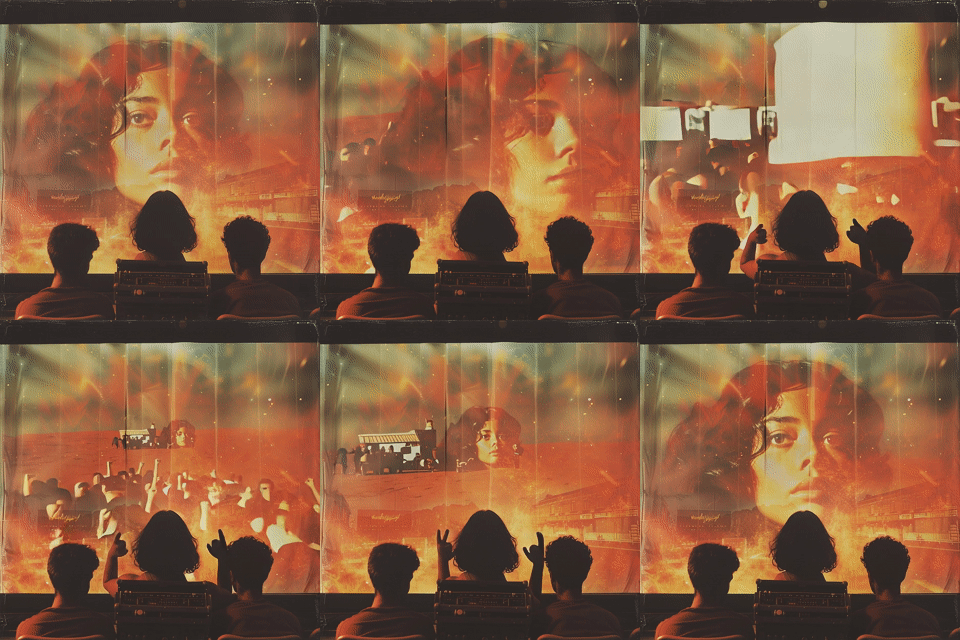
Returning to Cinema, Transformed by the Journey
Eight albums after their debut, Pachamaima returns to their cinematic origins—but transformed by everything that came between. Where Album I channeled specific film composers, this sequel engages with cinematic traditions themselves. The sequel is not repetition but spiral: the same concerns, higher altitude.
Eight albums after their debut, Pachamaima returns to their cinematic origins—but transformed by everything that came between. Where Album I channeled specific film composers (Morricone, Kilar, Shore), this sequel engages with cinematic traditions themselves: opening credits, noir, westerns, neorealism, nouvelle vague, Third Cinema.
The album both honors and transcends its predecessor—proving that Pachamaima's cinematic imagination has only grown richer. The sequel is not repetition but spiral: the same concerns, higher altitude.
Each track takes a cinematic tradition as its structural template. "Film Noir" doesn't just evoke noir—it follows noir's narrative arc (setup, investigation, confrontation, unresolved resolution). "Neorealism" doesn't just reference Italian cinema—it structures itself as an ordinary day, where nothing extraordinary happens and everything extraordinary happens.
The trio approaches these traditions as equals rather than students. They've earned the right to engage with Godard, with Solanas and Getino, with the entire history of cinema-as-art. This is mastery expressed through dialogue.
The Film Before the Film
Every great film begins before its first scene. Opening credits establish mood, genre, emotional contract. This track introduces each musician's voice—their "credit" in the film that is Pachamaima.
Opens with 3 seconds of silence—the darkened theater. Ralph enters alone with a yaravI-derived melody (his "credit"). At 2 minutes, Juan takes over with a palos pattern (his "credit"). At 4 minutes, Mariah enters with impressionist voicings (her "credit").
The final section: convergence—the "Pachamaima theme" that serves as the title card for this album and, in retrospect, for the entire nine-album cycle. The credits end. The film begins.
Shadows, Secrets, and the City at Night
American film noir created a musical vocabulary still heard today. But noir drew on German expressionism, French poetic realism, emigre composers fleeing Europe. The genre was always international—the American dream already shadowed by European nightmare.
Mariah opens with a chromatic descent—the femme fatale entering. Ralph's walking bass: the detective on rain-slicked streets. Juan plays with brushes, suggesting wet streets and cigarette smoke.
The track follows noir's narrative arc: setup, investigation, confrontation, unresolved resolution. The final chord doesn't resolve—noir tradition honored, closure denied.
The Good, The Bad and The Musician
Morricone's spaghetti westerns transformed film music forever. But Morricone was Italian, scoring American myths about a West that never existed, filmed in Spanish deserts. The western always existed in mythic space between reality and fabrication.
Opens with space—a single high note, the horizon stretching. The "hero's theme" develops as the journey begins. Tension builds through the middle section.
The showdown at 5 minutes: sudden silence, then explosion—the duel. Final section: the sunset ride, the theme transformed by experience. The hero rides away, changed.
Ordinary Lives Made Extraordinary
Italian neorealism proposed that ordinary people living ordinary lives was cinema's greatest subject. No glamour, no stars, no studio sets—just streets, faces, daily struggle for dignity. Rossellini, De Sica, Visconti: they found poetry in the quotidian.
Structured as a day. Morning: a folk melody, simple, hopeful. Work: tempo increasing, the labor of living. Afternoon: community emerges, call-and-response between instruments. Evening: tempo slowing, rest earned. Sleep: the music thinning to almost nothing.
Nothing extraordinary happened. Everything extraordinary happened.
When Jazz Became Cinema's Language
French New Wave changed the relationship between jazz and film forever. Miles Davis's score for Elevator to the Gallows, the cool jazz threading through Breathless—suddenly jazz wasn't just accompaniment but the film's psychological language. Jazz and cinema spoke the same syntax of improvisation.
The track channels 1960 Paris. Modal vamps, space between notes, "jump cut" rhythm where the beat seems to skip. A cafe scene: pure conversation, instruments talking like old friends. A chase section: sudden urgency, harmony darkening.
Jump cut to sudden calm. Final freeze frame: an unresolved chord, the last shot holding forever.
Revolutionary Film from the Global South
In 1969, Argentine filmmakers Fernando Solanas and Octavio Getino proposed "Third Cinema"—a revolutionary approach to filmmaking that served liberation struggles, was made collectively, shown clandestinely, and designed to transform viewers into actors. Cinema as weapon, as medicine, as mirror.
Three movements. Oppression: constrained, barely breathing, instruments muted. Resistance: building slowly, a people's theme emerging from the collective. Liberation: the breakthrough, full volume, full reverb, bright EQ—the chains broken.
Final section: not celebration but continuation. Liberation isn't an ending but a beginning. The struggle continues, transformed.
Final Convergence
End credits acknowledge that films are made by communities—hundreds of names scrolling past, each essential. This track serves as end credits for the entire nine-album cycle. The film ends. The cycle completes. The house lights rise.
Opens with a reprise of the Pachamaima theme from "Opening Credits." Then quotations begin: the noir theme, the western theme, the neorealist day, nouvelle vague's modal cool, Third Cinema's people's anthem—all appearing, all merging.
At 6 minutes, all six themes converge into a single harmonic statement—impossible, achieved. The final section extends further back, revisiting the entire nine-album journey. Seeds and signals. Water memory. Correspondences. All of it, in fragments, passing.
The music doesn't end triumphantly—it ends gently. Nine albums concluding. A cycle completing. The house lights rising. The audience returning to a world that the music, perhaps, has slightly changed.
Introduction - Mystery - Myth - Humanism - Cool - Revolution - Synthesis
Cinematic traditions rendered as jazz forms; each track engaging with a film genre as structural template
Where Album I channeled film composers, Album IX engages with cinematic traditions themselves—a dialogue between equals
The cycle's conclusion returns to its origins, transformed. The trio approaches cinema as equals rather than students—mastery through dialogue.