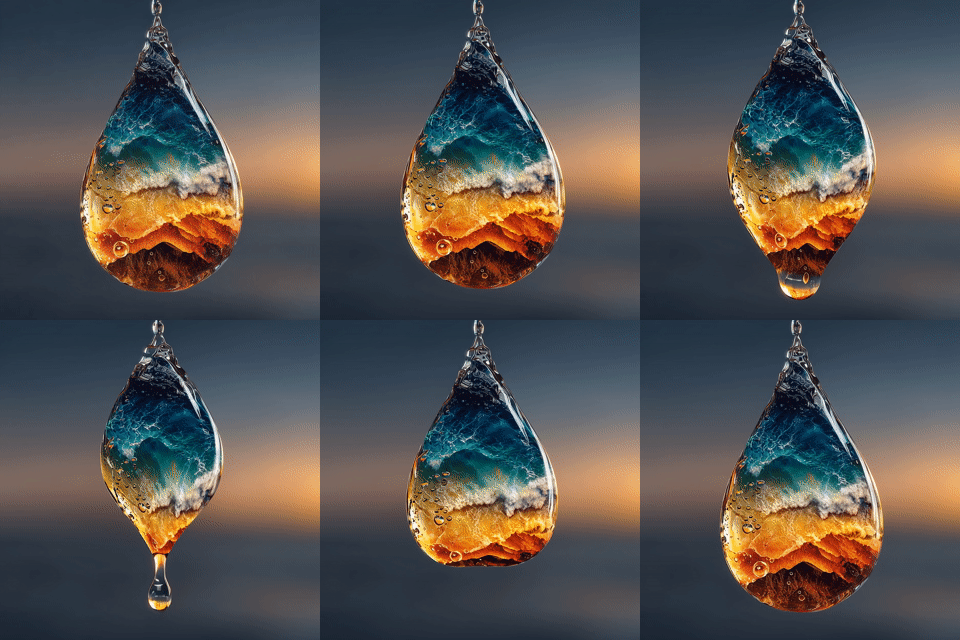
Water as Memory Carrier
The second album traces water's journey across three continents. Each composition explores how water carries cultural memory, emotional resonance, and ancestral wisdom through rivers, rain, and sea.
Water remembers everything it touches. This isn't metaphor but chemistry: molecules that fell as rain on Machu Picchu eventually evaporate, join clouds, travel across oceans, and fall again in Haiti or Alberta. Water connects continents, carries traces of everywhere it's been.
For Pachamaima, water becomes the conceptual thread linking their three heritages. The Andean Apus (mountain spirits) live in glaciers. The Caribbean diaspora traveled by water, and its rhythms echo the ocean's pulse. The Canadian prairies depend on snowmelt from distant mountains.
The album's sonic palette emphasizes fluidity, flow, and the different states of water:
Liquid passages: Legato bass lines, rolling piano arpeggios, flowing drum patterns that suggest rivers and rain.
Frozen moments: Sustained tones, crystalline piano harmonics, glacial stillness that represents ice and memory preserved.
Vapor transitions: Ethereal passages, fading dynamics, the evaporation between solid ideas.
Bahian Water Ritual
The album opens in Bahia, Brazil, where Ralph Quispe spent four years absorbing Afro-Brazilian music. Candomblé is a religion brought by enslaved Africans, preserved in water rituals that honor Yemanjá and other orixás. The "águas" (waters) here are both literal—the sea, the rivers—and spiritual: the waters of memory carrying African traditions across the Atlantic.
Ralph's bass opens alone, playing a berimbau-inspired pattern—the single-stringed instrument central to capoeira. The rhythm suggests waves, breath, the patient pulse of water against shore.
Juan enters with a candomblé rhythm, adapted from the sacred drums (atabaques) used in ceremony. The pattern is hypnotic, circular, designed to induce trance. Mariah's piano emerges gradually, playing a melody derived from Bahian popular music but voiced with impressionist harmonies—her Paris training filtering through Brazilian sensibility.
The climax builds through polyrhythmic density—multiple water currents converging—before subsiding into a gentle coda: the ritual complete, the waters calm.
Where Rivers Meet
Confluence is the meeting of rivers—the moment where separate waters become one. For Pachamaima, it's also the meeting of musical streams: the point where Andean, Caribbean, and North American influences merge. The track explores what happens at the intersection: turbulence, mixing, new colors emerging.
The piece begins with three separate melodic streams: Ralph playing an Andean-derived theme, Juan establishing a Caribbean groove, Mariah offering a jazz standard fragment. Each is in a different key, different tempo feel, different world.
Gradually, the streams bend toward each other. Ralph's melody modulates; Juan's groove adapts; Mariah finds common harmonies. The confluence itself is the album's first moment of complete unity—all three musicians playing the same theme, in the same key, breathing together.
After the confluence, the unified stream continues—transformed by the mixing. The melody is now shared property, belonging to no single tradition.
Becoming Invisible
Evaporation is water becoming invisible—present but unseen, rising to join clouds that will carry it elsewhere. For Mariah, this track connects to her prairie experience: watching morning mist rise from Canadian lakes, feeling moisture leave and knowing it travels to mountains she's never seen.
The quietest, most ethereal track on the album. Mariah leads with high-register piano harmonics—notes that barely speak, hovering at the edge of audibility. Ralph plays arco bass in the instrument's upper range, producing tones that shimmer rather than ground. Juan uses brushes on cymbals exclusively, creating white-noise textures like steam.
The piece has no clear melody—only suggestions of melody, fragments that rise and disperse. The dynamic never exceeds piano. The listener must lean in, straining to hear what's evaporating.
Cold Water, Warm Heart
The Humboldt Current carries cold Antarctic water up the Pacific coast of South America, creating the rich fishing grounds that sustained Andean civilizations for millennia. It's water as provider, as economic foundation, as the cold heart of warm cultures. Ralph grew up eating fish caught in Humboldt waters, understanding that the frozen south feeds the living north.
Ralph's bass carries the current—a deep, rolling pattern that suggests water moving purposefully through darkness. The harmonic language is cool, almost modal, influenced by Scandinavian jazz (Ralph's ECM listening) but grounded in Peruvian coastal rhythms.
Mariah's piano provides occasional warmth—moments of light penetrating cold depths. Juan's drumming is restrained, oceanic, suggesting vast distances and the patience of currents that have flowed for millions of years.
The track's longest section is a bass solo: Ralph alone with the current, meditating on the water that fed his ancestors.
Northern Memory
Lake Athabasca straddles the Alberta-Saskatchewan border, a remnant of the vast glacial lakes that once covered much of Canada. For Mariah, it represents northern memory: water holding the imprint of ice ages, Indigenous canoe routes, and the silence of vast, cold spaces.
Mariah opens with a solo piano meditation—spacious, hymn-like, influenced by her Métis grandmother's church music but stripped of religious specificity. The silence between phrases is as important as the notes.
When Ralph and Juan enter, they play so softly they're almost subliminal—the way sound carries across still water, arriving transformed by distance. The piece gradually builds to a modest climax before returning to Mariah alone, the lake freezing over, memory preserved under ice.
Ocean of Tears
The album's emotional center. The Middle Passage—the Atlantic crossing that brought enslaved Africans to the Americas—is the defining trauma of Caribbean history. Juan Reyes's ancestors survived it; the rhythms he inherited were preserved despite it. This track honors those who crossed and those who didn't.
The track is structured in three sections:
Africa (0:00-4:00): Juan plays West African rhythms learned during his Dakar years, establishing the homeland that would be stolen. Mariah and Ralph support with minimal, respectful accompaniment.
Crossing (4:00-8:00): The rhythms fragment, distort, become disorienting. Ralph's bass suggests the terrifying roll of the ship; Mariah's piano provides no comfort, only dissonance. Juan plays a single repeated pattern—the heartbeat that kept people alive in the hold.
Arrival (8:00-12:00): The African rhythms return, transformed by the crossing but unbroken. Juan plays palos, showing how the Dominican tradition preserved what the Middle Passage tried to destroy. The piece ends not in triumph but in resilience.
The Storm That Cleanses
The album closes with a Caribbean hurricane—water at its most violent and most purifying. In Dominican culture, storms are respected, even welcomed: they clear dead growth, refresh aquifers, and remind humans of forces beyond control. The tormenta is both destruction and renewal.
The most dynamically extreme track. It begins with ominous stillness—the pressure drop before the storm. Then Juan unleashes: full kit, maximum intensity, the hurricane arriving.
Mariah and Ralph play through the chaos, their melodic lines fragmenting and reforming like trees in wind. The trio pushes to the edge of what they can play together—controlled chaos, the eye approaching.
At the six-minute mark: silence. The eye of the hurricane, peaceful and terrifying. Then the second half of the storm, equally violent, before the gradual clearing.
The coda is aftermath: rain tapering to drips, the world washed clean, everything the same but different. The album ends with a single bass note—water settling into new channels, memory refreshed.
Ritual initiation, convergence, ethereal transition, deep memory, northern silence, historical trauma, cathartic release
Flowing, liquid textures; extreme dynamic range; emphasis on sustain, reverb, and decay; moments of crystalline stillness
Every track explores water in a different state or context, but the connective thread—water as memory carrier—holds the album together
After the cinematic debut, this album establishes that Pachamaima can sustain a conceptual arc while deepening their musical synthesis